
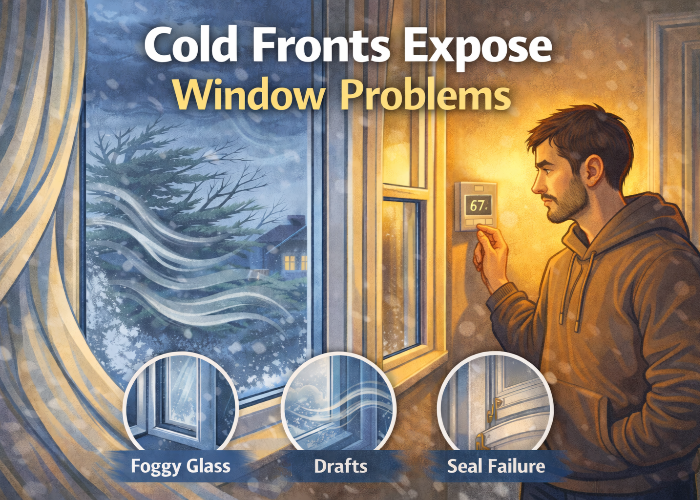
Winter cold fronts can move through North Texas, often bringing sharp temperature changes, strong winds, and overnight drops that stress home exteriors. While these fronts may only last a few days, they often reveal window problems homeowners didn’t realize they had.
At Conservation Construction of Dallas, we hear from homeowners who notice the same pattern every winter. Each cold front brings uneven room temperatures, drafty windows, and heating systems that seem to work harder without improving comfort.
In many cases, the issue isn’t the heater at all. It’s your windows.
Homes built for Texas summers can lose heat quickly during sudden cold snaps, especially through older glass and worn seals.
Energy-efficient windows help tighten up those weak points and restore comfort when cold fronts move through.
Cold fronts are tough on windows because they combine rapid temperature change with wind pressure. That combination exposes weak points that may go unnoticed during mild weather.
Here’s the science in plain terms. Heat naturally moves toward cold. When outdoor temperatures drop quickly, window glass and frames cool fast. If seals around the window are worn or the glass is outdated, heat escapes more easily through those surfaces. Wind makes it worse by pushing cold air against the home, forcing it through even tiny gaps around frames and sashes.
According to the University of Massachusetts Amherst Building and Construction Technology program, “Air leakage siphons about half of an average home’s heating and cooling energy to the outdoors,” much of it occurring through and around windows.
When we talk about window performance, we are really talking about two things homeowners feel every day:
If performance is slipping, you feel it as cold rooms near windows, drafts that come and go with the wind, and heating systems that work harder without improving comfort.
Cold fronts do not create these problems. They simply make existing weaknesses easier to notice.

Instead of one obvious failure, problems tend to build gradually.
Common signs include:
If these symptoms recur each winter, windows are often the culprit.
Each of these points leads back to either heat escaping through the glass or air slipping around the frame. Cold fronts amplify both problems at once.
The best time to diagnose in North Texas is during the wind, not after the front passes. On a windy day, stand near the window and feel along the side rails and sill. If you notice moving air, listen to it. Whistling or curtains shifting slightly can point to leakage at the frame.
Then do a room comparison. If one room cools down much faster than the rest of the home after the heat shuts off, windows are often part of the reason, especially on the wind-facing side of the house.
Also, check the operation. If the window feels tight at the bottom but loose at the top, or locks no longer line up cleanly, that often points to a frame shift affecting how tightly the window closes.
Seal failure means the panes no longer insulate together, reducing the window’s ability to block heat loss.

Small fixes can make sense when the problem is limited, and the window itself is still in good shape. For example:
Window replacement becomes the more practical option when issues are ongoing or show up in multiple rooms, such as:
At that stage, upgrading to energy-efficient windows in Dallas becomes less about fixing a single problem and more about improving overall comfort during frequent cold fronts and temperature swings.
Because North Texas can see frequent temperature swings and strong winds, installation quality matters as much as the window itself. Proper fit, consistent sealing, and correct alignment help windows handle pressure changes without leaking air.
A rushed installation can leave small gaps that cause drafts, rattling, and comfort issues that never fully go away. Even a well-made window can underperform if it is not installed correctly.
A quality installation verifies the opening, corrects alignment issues, and checks operation before the crew leaves, so the window seals the way it should.

A longer heating cycle means your heater is failing.
During cold fronts in North Texas, homeowners often notice cold rooms near windows or uneven room temperatures. That does not automatically mean the furnace is broken. Often, the system is working properly but losing ground to window drafts, drafty windows, or minor window seal failure that allows heat to escape.
If a window looks closed, it must be sealed.
Windows letting cold air in are not always obvious. Air leaks around window frames, worn weatherstripping, or poor window installation can allow cold air to enter near windows, even when the locks appear tight. Small gaps you cannot see can still create noticeable discomfort during strong winter winds.
Cold glass always means there is a draft.
Not every cold surface means active airflow. Older glass can feel cold without true air movement, still pulling heat from the room and making it uncomfortable. However, visible fog between window panes is a strong sign of window seal failure, which reduces insulation performance even if you do not feel direct air leaks.
If the same rooms feel uncomfortable after every cold front, or if drafts and condensation keep returning, a professional evaluation can help clarify what is really happening.
A window assessment looks at glass condition, sealing, alignment, and installation factors to determine whether simple fixes will help or if replacement is the more practical solution.
Homeowners can schedule a consultation with Conservation Construction of Dallas to have their windows evaluated and receive recommendations for energy-efficient windows to improve comfort and performance during North Texas cold fronts.
