
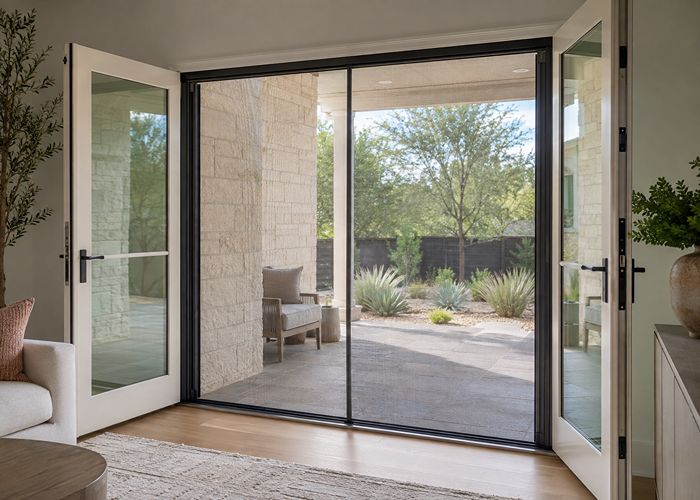
Yes, retractable screens can work with French doors. Many systems use two screen panels that pull from opposite sides of the doorway and meet in the center. When the screens aren't needed, the mesh rolls back into slim housings along the sides, leaving the French doors visible and the opening clear.
That makes retractable screens an appealing option if you want to open both doors for fresh air without adding permanent screen doors to the entrance.
The fit matters, though. French doors create a wider opening with no permanent center jamb, so the screen configuration, alignment, tracks, and closure all need to work together. Understanding those parts can also make it easier to spot common retractable screen door problems when something isn't working properly.

A manual retractable screen uses flexible mesh attached to a roller inside a narrow housing, sometimes called a cassette. The housing is mounted vertically along the side of the doorway.
Pull the screen across and the mesh travels through guides at the top and bottom of the opening. Release or open the screen according to the system's design, and the mesh rolls back into its housing.
French doors commonly require two of these screen assemblies. One is installed on each side, allowing the screens to extend toward each other and meet in the center. Depending on the product, a magnetic or mechanical closure can hold the two sides together.
This setup gives you several ways to use the doorway. You can screen the entire opening when both French doors are open, use one side for everyday traffic, or retract both screens when you want the doorway completely clear.
Because French doors vary in height, width, swing direction, handles, frames, and thresholds, accurate measurements are important. The screen needs to fit the opening without interfering with how either door operates.

Tracks, mesh, tension, rollers, and alignment all affect how a retractable screen moves. When a problem develops, the symptom can offer a useful clue about where to look.
If the screen becomes difficult to pull or doesn't retract as smoothly as it once did, check the tracks for visible dirt, leaves, pet hair, or grit.
Keep the tracks clean and follow the manufacturer's maintenance instructions before applying any lubricant.
When clean tracks don't solve the problem, uneven movement can indicate an issue with alignment, screen tension, or the roller mechanism. Avoid repeatedly forcing a screen that doesn't want to move. Doing so can damage the mesh or hardware.
An occasional impact against the mesh can knock some retractable screens out of position. Repeated problems are more concerning.
A screen that frequently comes loose may have worn guides, poor alignment, incorrect tension, or another fit issue. If the same section repeatedly comes out of place, simply putting it back into the track may not address the cause.
Retractable screen mesh should stay reasonably taut while it's extended across the doorway.
Sagging, bunching, or wrinkles may develop when the tension isn't correct or the mesh has become worn or damaged. Poor alignment can also affect how evenly the material travels into the housing.
If cleaning the tracks doesn't improve the way the mesh moves, the screen may need adjustment or repair.
Center alignment is particularly important with French doors.
Two screens that are supposed to meet in the middle shouldn't leave a significant opening for insects to pass through. A gap, uneven meeting point, or closure that won't connect properly can indicate an alignment, fit, or hardware problem.
The doorway itself can contribute, too. If the opening is out of square, getting two retractable panels to meet evenly can become more difficult.

A screen that worked well for years and recently started sticking may simply need cleaning or routine service.
A screen that has been difficult to operate since it was installed tells a different story.
Repeated derailment, uneven retraction, persistent gaps, poor center alignment, or difficulty opening and closing from the beginning can point toward measurement, installation, or mechanical issues.
This distinction is worth making before replacing parts. Cleaning debris won't correct a poorly fitted screen, while adjusting an entire system isn't necessary if grit in the track is causing the problem.

A retractable screen and a storm door can both allow ventilation while keeping insects outside, but they aren't designed to do exactly the same job.
The simplest distinction is this:
A retractable screen is primarily for fresh air and insect protection, and it disappears when you aren't using it.
A storm door is a permanent secondary exterior door that can add another layer between your primary door and outdoor weather.
The French-door configuration is especially important here.
Adding storm doors over a double-door opening can be more complicated than adding one to a standard single entry door. The system needs to accommodate both doors and the center of the opening. A retractable system avoids permanent secondary doors by storing the screen material along the sides instead.
If additional weather protection is your main concern, a storm door may still be the better fit. If you mainly want ventilation, insect protection, and an unobstructed view of the French doors when the screen isn't being used, a retractable screen is likely the more natural choice.
A good screen needs to do more than cover the opening. It should operate smoothly and fit the way you actually use the doors.
For French doors, consider:
If you have pets, children, or a doorway that gets frequent use, mesh durability may deserve additional attention.
For much larger openings, such as covered patios or expansive outdoor living areas, a motorized screen may make more sense than a manually operated door screen. That allows a larger screen to raise and lower without requiring the same side-to-side operation used at a typical French door.
One reason people choose French doors is their appearance. Large glass panels can bring more natural light into the room and create a visual connection with a patio, deck, or backyard.
A permanent secondary door changes that view even when it isn't being used.
Retractable screens take up much less visual space when they're open because most of the mesh is stored inside the side housings. The housings remain visible, but the screen itself isn't stretched across the glass all day.
For decorative French doors, that can be one of the biggest advantages of choosing a retractable design.
If you want fresh air through your French doors without permanently covering the opening with another set of doors, Conservation Construction of Dallas can discuss retractable screen options for your home.
Our team can look at the size and configuration of your doorway, how you plan to use the opening, and the screen options available for the space. Conservation Construction of Dallas also offers screen solutions for larger outdoor areas, including motorized retractable screens for patios and other wide openings.
Explore our retractable screen options or contact Conservation Construction of Dallas to request a free estimate and find the right screen setup for your home.
